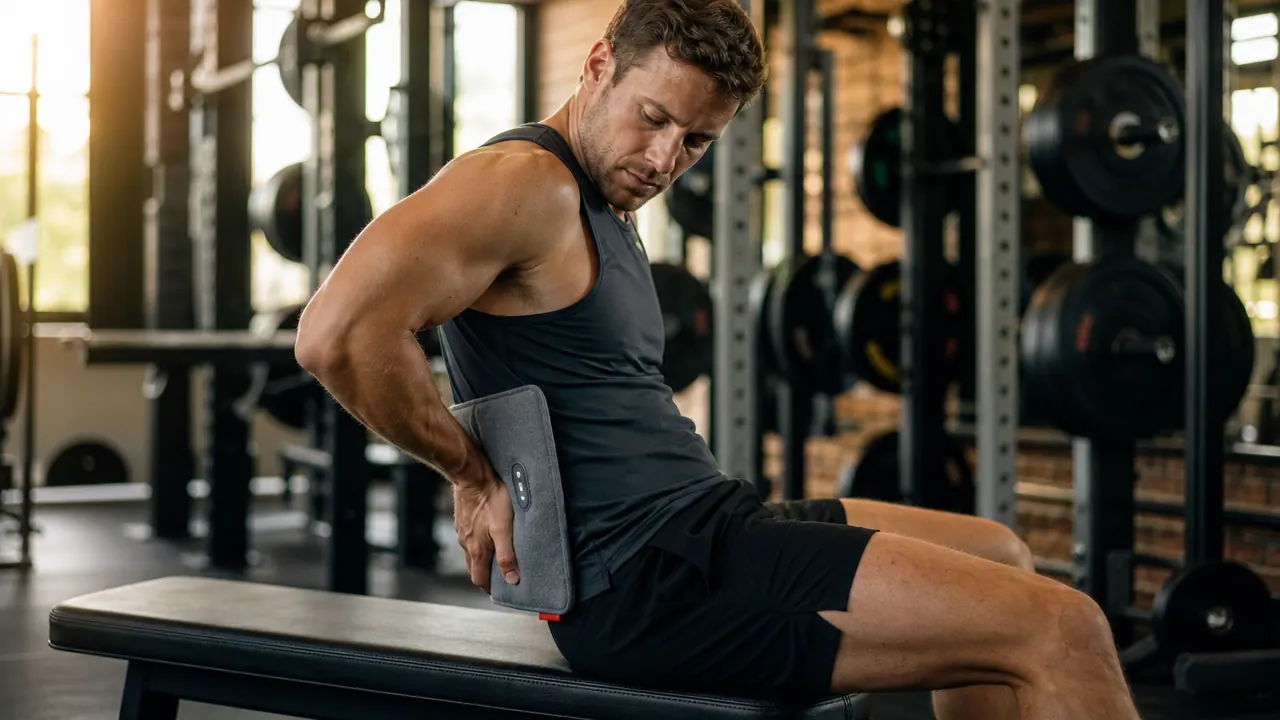
You finished a heavy lower-body session on Wednesday night. Thursday morning your quads feel like they were run through a meat tenderizer. You grab your heating pad, press it against your legs for twenty minutes, and wonder why it does not seem to help much. Here is the problem: heat applied too soon after training, especially before the acute inflammation window closes, does not accelerate recovery. It can slow it down. The timing question is not trivial, and most of the advice floating around the internet skips over it entirely.
This guide gives you a practical, sports-medicine-backed protocol for using the Deepsoon Electric Heating Pad after strength training. You will know exactly when to apply it, what temperature to set, how long to hold each session, which muscle groups respond best, and the common mistakes that turn a useful recovery tool into a problem. If you follow these steps consistently over two to three weeks, you will notice a real difference in how you feel going into your next session.
Your quads are stiff and you want them loose by morning. Start with the right tool.
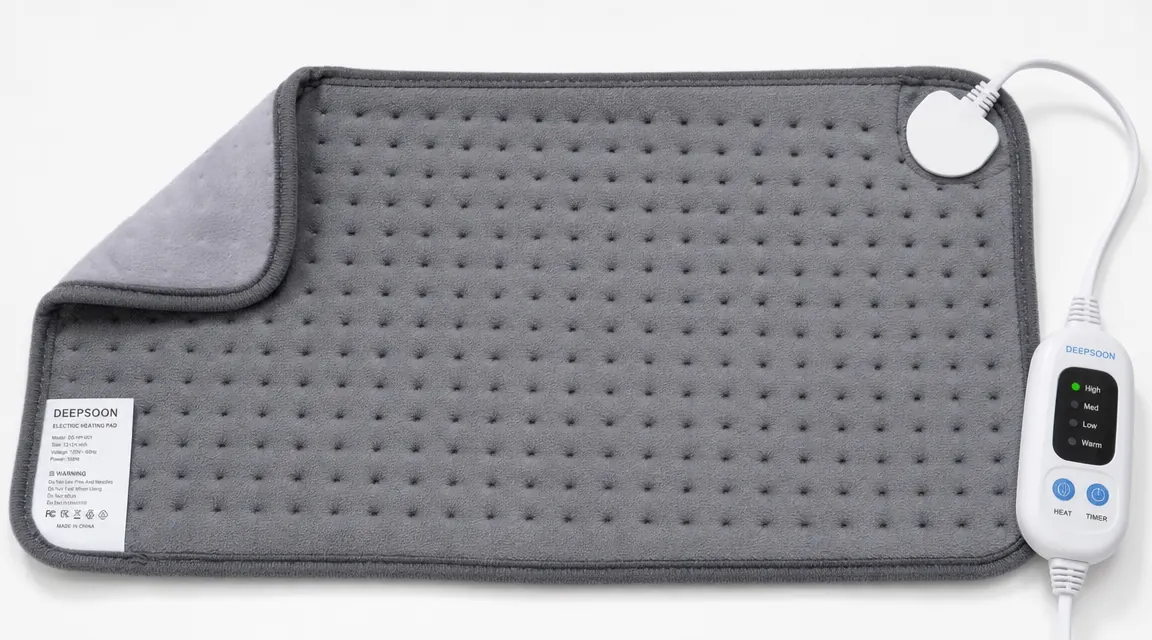
The Deepsoon Heating Pad hits six temperature levels, includes a moist heat layer for deeper tissue penetration, and has an auto-shutoff at 90 minutes so you do not have to babysit it. Over 23,000 reviews. Check today's price on Amazon.
Amazon Check Today's Price on Amazon →Step 1: Identify Whether You Have DOMS or an Acute Injury
This is the step most people skip, and it matters more than anything else in the protocol. Delayed onset muscle soreness (DOMS) is the diffuse, achy tightness that usually peaks 24 to 72 hours after a hard session. It is not the same as acute injury. DOMS is the byproduct of eccentric muscle damage and the low-grade inflammatory cascade your body uses to repair and rebuild tissue. It is uncomfortable but not dangerous.
Acute injury looks different. If you felt a sharp pop or pull during your session, if the area is visibly swollen within 30 to 60 minutes after training, or if you have point tenderness at a specific spot rather than a broad aching sensation across the whole muscle belly, do not use heat. Not for 48 hours at minimum, and ideally not until you have had it evaluated. Applying heat to true acute inflammation accelerates blood flow and edema, which increases swelling and delays tissue repair. The rule is simple: if there is swelling, use ice or compression first. Heat comes later.
For standard DOMS with no swelling, no localized sharp pain, and no mechanism of injury during your session, you are a candidate for heat therapy starting around the 24-hour mark. That is the window this protocol is designed for.
Step 2: Wait at Least 24 Hours Post-Session Before Applying Heat
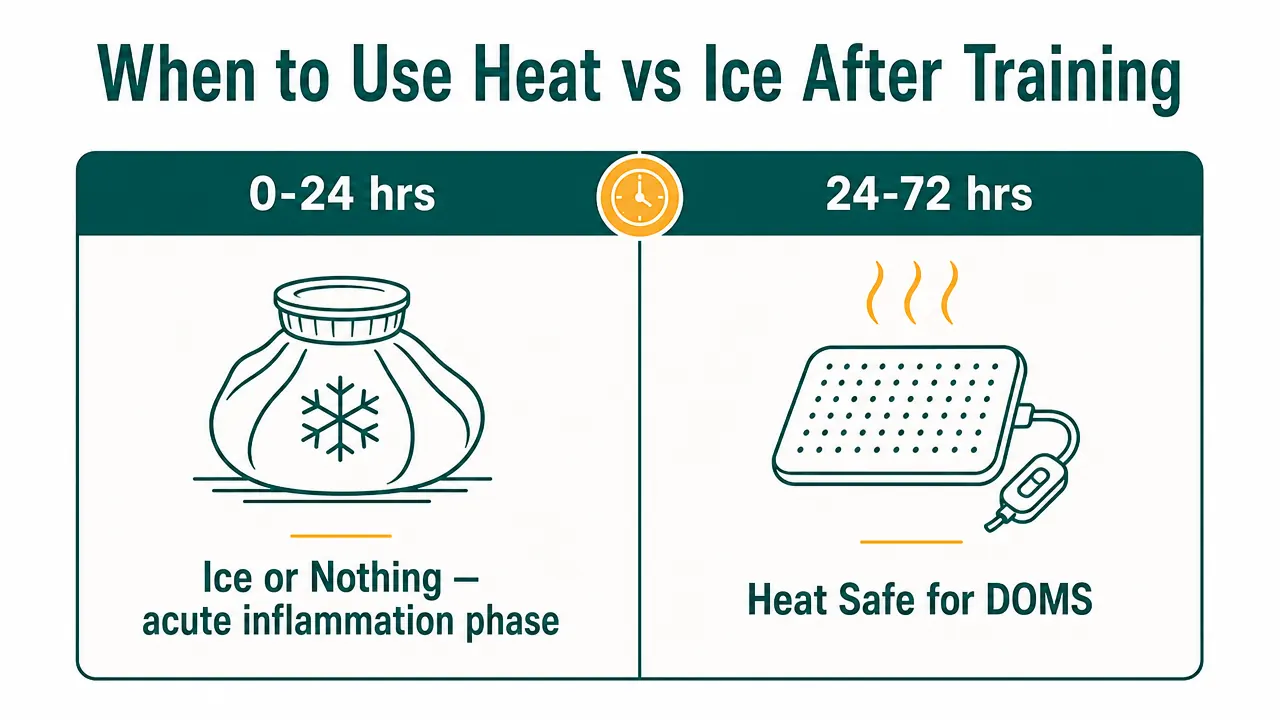
The advice to 'apply heat right after a workout' comes from physical therapy contexts where the goal is pre-activity tissue warm-up, not post-training recovery. After strength training, your muscle fibers have sustained micro-damage, and your body has already initiated the inflammatory repair response. The inflammatory phase runs roughly 0 to 24 hours post-session. During this window, the body is doing what it is supposed to do. Adding heat vasodilates local blood vessels and can prolong or intensify that inflammatory phase when your goal is to let it pass and move into the proliferative repair phase.
Practical application: if you lift Monday evening, do not reach for the heating pad Monday night. Tuesday morning, once your soreness has shifted from a warm, acute feeling to the heavy, stiff ache of true DOMS, the 24-hour window has typically passed and heat becomes appropriate. For very intense sessions like heavy squats or Romanian deadlifts, some coaches push that window to 36 to 48 hours before introducing heat. When in doubt, wait longer.
The inflammatory phase runs 0 to 24 hours post-session. Heat during that window does not accelerate recovery. It competes with it.
Step 3: Set the Deepsoon to the Right Temperature Level
The Deepsoon pad has six temperature settings. For muscle recovery after strength training, you want a medium setting, roughly the third or fourth level, which corresponds to approximately 104 to 113 degrees Fahrenheit (40 to 45 degrees Celsius). This range is sometimes called therapeutic warmth. It is warm enough to meaningfully increase local blood flow and tissue extensibility without reaching noxious heat levels that trigger a pain withdrawal response or risk a contact burn.
The higher settings (five and six) are generally more appropriate for acute pain or stiffness where a person needs the strongest possible thermal stimulus. For ongoing post-training recovery, where your goal is to sustain warmth over 15 to 20 minutes rather than deliver maximum heat quickly, a medium setting achieves better total tissue penetration because the body does not reflexively guard or tighten against the temperature. If you are using the moist heat function, drop down one setting level from where you would normally start. Moist heat transfers thermal energy more efficiently than dry heat at the same dial position, so the effective tissue temperature will be higher than the setting suggests.
One practical note: do not use the heating pad on any setting if your skin is already reddened, if you have applied topical analgesic creams like lidocaine or menthol-based gels to the area, or if you have recently used a topical corticosteroid. Numbing agents reduce your ability to detect excessive heat at the skin level, which removes the feedback mechanism that protects you from a contact burn.
Step 4: Activate Moist Heat for Deeper Muscle Penetration
The Deepsoon pad includes a moist heat function activated by dampening the included fabric cover and placing it between the heating element and your skin. This is not a gimmick. Moist heat is consistently preferred over dry heat in sports-medicine and physical therapy contexts because water conducts thermal energy roughly 25 times more efficiently than still air. A dry heating pad warms the skin quickly but loses much of that energy before it reaches the deeper muscle tissue. Moist heat penetrates to the muscle belly more effectively at the same surface temperature.
To activate: dampen the cover with room-temperature water and wring it out until it is just slightly moist, not dripping. You want a thin layer of moisture at the surface, not a soaked cloth. Place the damp cover over the pad, then position the pad on the target muscle group. The perceived temperature difference will be noticeable within the first two minutes. For large muscle groups like the lower back, hamstrings, or quads, moist heat is the better choice. For smaller areas like the shoulders or neck, dry heat works fine, though moist is still the more efficient option.

Step 5: Position the Pad Correctly for Your Target Muscle Group
Coverage matters. The Deepsoon pad is 12 by 24 inches, which is large enough to cover most single-muscle-group recovery sessions in a single placement. For the lower back, lay the long axis of the pad horizontally across the lumbar region, covering from iliac crest level up to mid-thoracic. For quads or hamstrings, orient the long axis vertically down the front or back of the thigh. For shoulders and upper traps, drape the pad across the top of the shoulder with the pad curving slightly forward and back.
Lie down or sit in a fully supported position for the duration of the session. Do not try to use the heating pad while doing light mobility work or stretching during a recovery session. The vasodilation effect is maximized when the muscle is at rest and not under tension. If you want to stretch a tight muscle group, do it before you apply heat, or wait until after the session ends and the tissue has had five minutes to cool slightly. Stretching a maximally vasodilated muscle is a higher injury-risk scenario than it sounds.
Avoid placing the pad directly under your body weight. Lying on top of a heating pad creates prolonged, concentrated pressure that raises the effective skin temperature beyond safe levels even at moderate dial settings. Always drape it on top of the target area, never beneath it.
Step 6: Hold Each Session to 15 to 20 Minutes
Fifteen to twenty minutes is the evidence-supported sweet spot for a single heat therapy session on a muscle group. During this window, local blood flow increases, muscle spindle activity decreases (which is why you feel looser), and tissue extensibility improves. Beyond 20 minutes on the same spot, the marginal benefit flattens. The body adapts thermally, and you no longer get additional vasodilation from continued exposure. You are just keeping the tissue warm at that point, which is not harmful but is not giving you more benefit.
The Deepsoon's 90-minute auto-shutoff is a safety backstop, not a session-length guide. Do not treat the shutoff as the target duration. Set a timer for 20 minutes when you start and remove the pad when it goes off. If you fall asleep with the pad on, which is an extremely common scenario, the auto-shutoff at 90 minutes means you will not wake up with a contact burn. But habitually sleeping through your session duration defeats the purpose of a controlled protocol.
For multi-muscle-group recovery days (say, lower back and hamstrings after a heavy deadlift session), run two separate sessions with a 10-minute break between them rather than repositioning mid-session. The break allows your skin temperature to normalize, which prevents the kind of cumulative skin heating that increases burn risk. Two clean 15-minute sessions beats one wandering 30-minute session every time.
What Else Helps Alongside Heat Therapy
Heat therapy works best as one component in a broader recovery stack, not a standalone fix. The three most effective complements are hydration, light movement, and sleep. Hydration matters because vasodilation increases blood volume demand in the target area. If you are dehydrated when you apply heat, you are amplifying the demand on a system that is already short on resources. Drink 16 to 20 ounces of water in the hour before a post-training heat session.
Light movement after your heat session, specifically 10 to 15 minutes of low-intensity walking or cycling, flushes the metabolic waste products that heat therapy helps mobilize. Heat moves the blood in. Movement moves the blood out. You need both directions of flow for the recovery benefit to be complete. This is why heat-then-walk is a classic physical therapy prescription for DOMS and general muscle stiffness.
Sleep is where the tissue actually repairs. Heat therapy before bed is particularly effective because it lowers your core temperature after the session ends (the thermogenic rebound effect), which is one of the physiological triggers for deeper sleep onset. A 20-minute heat session on a sore muscle group 60 to 90 minutes before bed can double as both a recovery tool and a sleep primer. That is a good use of an inexpensive piece of equipment.
Heat moves the blood in. Movement moves the blood out. You need both directions for the recovery benefit to be complete.
Common Mistakes That Stall Your Recovery
The most common mistake is applying heat immediately after training before the acute inflammatory window closes. The second most common is lying on top of the pad rather than placing it on top of the target area. Both raise effective skin temperature unpredictably and can cause burns or prolong soreness.
A third mistake is applying heat over any topical cream or analgesic, including menthol gels, lidocaine patches, arnica creams, or even heavily applied deep-tissue balm. These agents interfere with your skin's heat-sensing accuracy. The combination of a topical analgesic plus a heating pad is a known mechanism for contact burns, especially at higher temperature settings. Always apply heat to clean, product-free skin.
Overextending session time is the fourth mistake. Once you hit the 20-minute mark, the skin has thermally adapted and continued exposure provides minimal additional muscle benefit while the risk of skin irritation slowly increases. Longer is not better with heat therapy. Consistent and correctly timed is better.
Finally, heat is not a substitute for sleep, hydration, or nutrition. Lifters who are chronically under-slept and under-fueled sometimes use heat therapy as a coping mechanism for soreness that would resolve faster if they addressed the root inputs. Heat helps. It does not compensate.
Six temperature levels, moist heat function, and an auto-shutoff that means you can actually relax during the session.
The Deepsoon Heating Pad covers the full lumbar region, shoulders, quads, or hamstrings in one placement. At 4.4 stars across more than 23,000 reviews, it is the most-used electric heating pad in the recovery-focused training community. See today's price on Amazon.
Amazon Check Today's Price on Amazon →